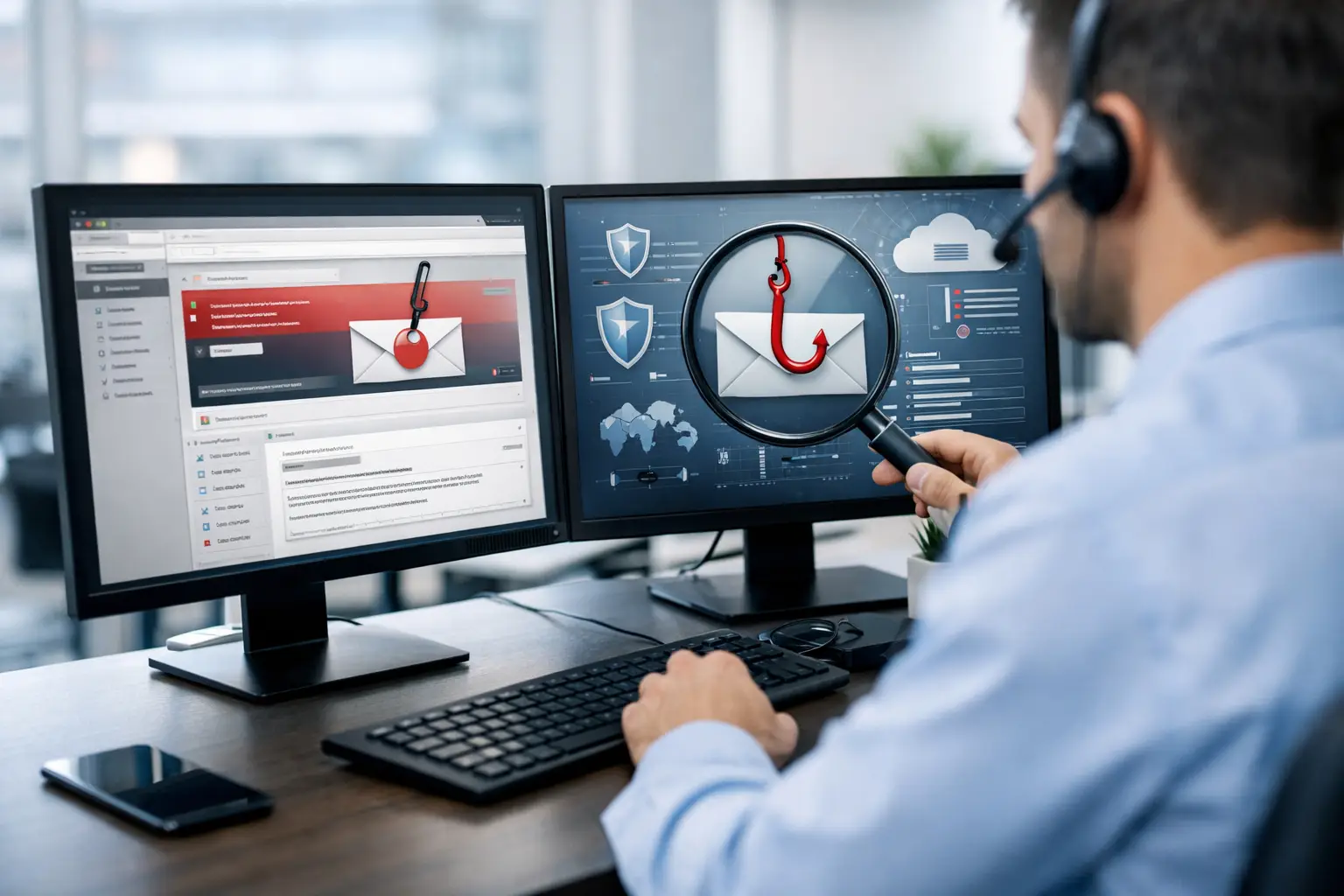
A reported phishing email is not simply a ticket to close. It may be the first indication that a credential-harvesting campaign has reached hundreds of users, that a supplier has been impersonated, or that a payment fraud attempt is already under way. A managed phishing triage service gives security teams the operational capacity to assess those reports quickly, contain confirmed threats and turn employee reporting into actionable intelligence.
For UK organisations running Microsoft 365, the issue is rarely a lack of email security controls alone. The practical challenge is deciding what each suspicious message means, whether it exists elsewhere in the tenant, and who will take responsibility for the response when the SOC, service desk or security team is already managing competing priorities.
Why reported email needs an operational response
Secure email gateways, Microsoft 365 protections and authentication controls reduce a significant volume of unwanted email. They do not stop every threat. Targeted phishing, business email compromise, compromised supplier accounts and QR-code campaigns are designed to evade automated controls or exploit trusted communications channels.
Employees are therefore a valuable detection layer. When they can report suspicious messages directly from Outlook, organisations gain visibility of attacks that might otherwise remain in inboxes until a user clicks, replies or transfers funds. But a reporting mechanism without timely analysis can create a different problem: a growing queue of unreviewed submissions, inconsistent decisions and reduced employee confidence in the process.
If people receive no meaningful response after reporting a suspicious email, they may reasonably assume that reporting does not matter. If analysts spend large parts of the day reviewing harmless newsletters, marketing messages and routine spam, higher-risk incidents can receive less attention than they require. Effective human risk management depends on both participation and a credible response model.
What a managed phishing triage service should do
A managed service should provide more than alert handling. Its purpose is to run a defined phishing response workflow, with clear evidence, escalation paths and actions that fit the customer’s Microsoft 365 environment.
At the point of submission, the service should inspect the message, its headers, sender infrastructure, URLs, attachments and relevant indicators of compromise. Analysts then determine whether the email is malicious, suspicious, spam or benign, and identify the likely threat type. This classification matters because the response to a credential-harvesting page is different from the response to a suspected invoice fraud email or a malware-bearing attachment.
For confirmed phishing, triage should establish scope. Was the same message delivered to other recipients? Are similar sender domains, URLs or file hashes present elsewhere? Has an employee interacted with the email? Scope assessment allows the organisation to move from examining a single report to containing a campaign.
The next stage is remediation. Depending on agreed permissions and operating procedures, this can include removing matching messages from mailboxes, blocking malicious domains or URLs, and escalating potential account compromise for investigation. A useful service records what was found, what action was taken and what remains with the customer’s internal team. This provides assurance during an incident and supports later review.
Triage is not the same as a mailbox monitoring service
The distinction is important for procurement and service design. Mailbox monitoring may identify suspicious traffic, but phishing triage is centred on investigation and decision-making. A mature service combines human analysis, phishing-specific intelligence, repeatable playbooks and the ability to drive remediation.
Equally, not every organisation needs a fully outsourced incident response function. Some have an established SOC that needs surge support or specialist phishing analysis. Others need analysts to handle the full reported-email queue, with defined escalation for high-severity incidents. The right model depends on reporting volume, internal expertise, coverage requirements and the organisation’s authority to make mailbox changes.
Building the service around Microsoft 365
Microsoft 365 is central to the daily communications of most UK enterprises, and phishing response needs to work with that operational reality. A service should be able to examine email evidence accurately and support the search and removal of malicious messages across relevant mailboxes. It should also account for the security controls already in use, so that remediation complements rather than conflicts with internal processes.
Access design deserves careful attention. Security leaders need to agree what the managed team can view, what it can action and what requires customer approval. Least-privilege access, documented roles and auditable actions are especially relevant in regulated sectors, where email investigation may involve sensitive personal, financial, legal or patient information.
Integration is only one part of the design. Clear runbooks are equally important. A payment-diversion attempt may require rapid involvement from finance and legal teams. A suspected credential theft may require account review, token revocation and user support. A malicious attachment may need endpoint and wider incident response processes. Triage should provide the evidence that allows those teams to act without delay.
The measures that show whether the service is working
A managed service should produce operational measures that help security leaders understand risk and resource demand. Ticket volume on its own is not enough, particularly when employee awareness activity increases reporting. More reports can be a positive sign if they result from stronger security participation rather than more successful attacks.
Useful measures include time to initial assessment, time to containment for confirmed threats, the proportion of reports classified as malicious or suspicious, campaign recurrence and the number of messages remediated beyond the original report. Trend reporting should show common impersonated brands, recurring lures, departments receiving the most targeted messages and the techniques that are bypassing existing controls.
These findings should inform wider phishing defence. If triage repeatedly identifies QR-code lures, simulated phishing training can address that behaviour. If supplier impersonation is a recurring issue, finance verification procedures may need reinforcement. If users report genuine business messages because of unfamiliar sender patterns, the organisation can improve guidance without discouraging reporting.
This feedback loop is where triage becomes a practical source of threat intelligence rather than an isolated service desk activity. It connects employee behaviour, real adversary activity and technical controls.
Questions to ask before appointing a provider
Security and procurement teams should test how a prospective service operates in practice. Ask who performs analysis, what evidence is retained, how severity is assigned and what response times apply outside normal office hours. It is also worth confirming whether the provider can support Microsoft 365 remediation or only provide recommendations.
The escalation model should be unambiguous. Define which events trigger immediate telephone escalation, who can approve removal actions, and how the provider hands over an incident that requires endpoint, identity or fraud investigation. A service that is strong at email analysis but disconnected from the customer’s incident process can still leave costly gaps.
For partners and MSPs, multi-customer separation, reporting consistency and the ability to offer a specialist phishing capability under an agreed commercial model are additional considerations. The service must give the partner enough visibility to manage its customer relationship while maintaining appropriate security boundaries.
Organisations should also assess the provider’s phishing focus. Broad security operations services can be appropriate where a single team manages many alert types. However, phishing-led compromise has distinct operational requirements: analysing social-engineering context, understanding email delivery patterns, identifying lookalike infrastructure and remediating messages at scale. Specialist expertise is valuable when email is a major business risk.
Managed phishing triage service as part of a wider programme
A managed phishing triage service is most effective when it sits within a complete workflow: employees receive relevant training, report suspicious emails easily, analysts investigate submissions, confirmed threats are removed, and lessons from each incident improve controls and user guidance.
Wise Fish supports this operational lifecycle through phishing-focused consultancy, enablement and managed response capabilities, combining Cofense expertise with UK-focused delivery. The objective is not to create more security activity. It is to make reported email a dependable control that reduces the time between detection and containment.
The practical test is straightforward: when the next convincing phishing email reaches an inbox, the organisation should know who will assess it, how quickly they will act, what can be removed and how the learning will strengthen the next response. That certainty is often more valuable than another unattended alert queue.