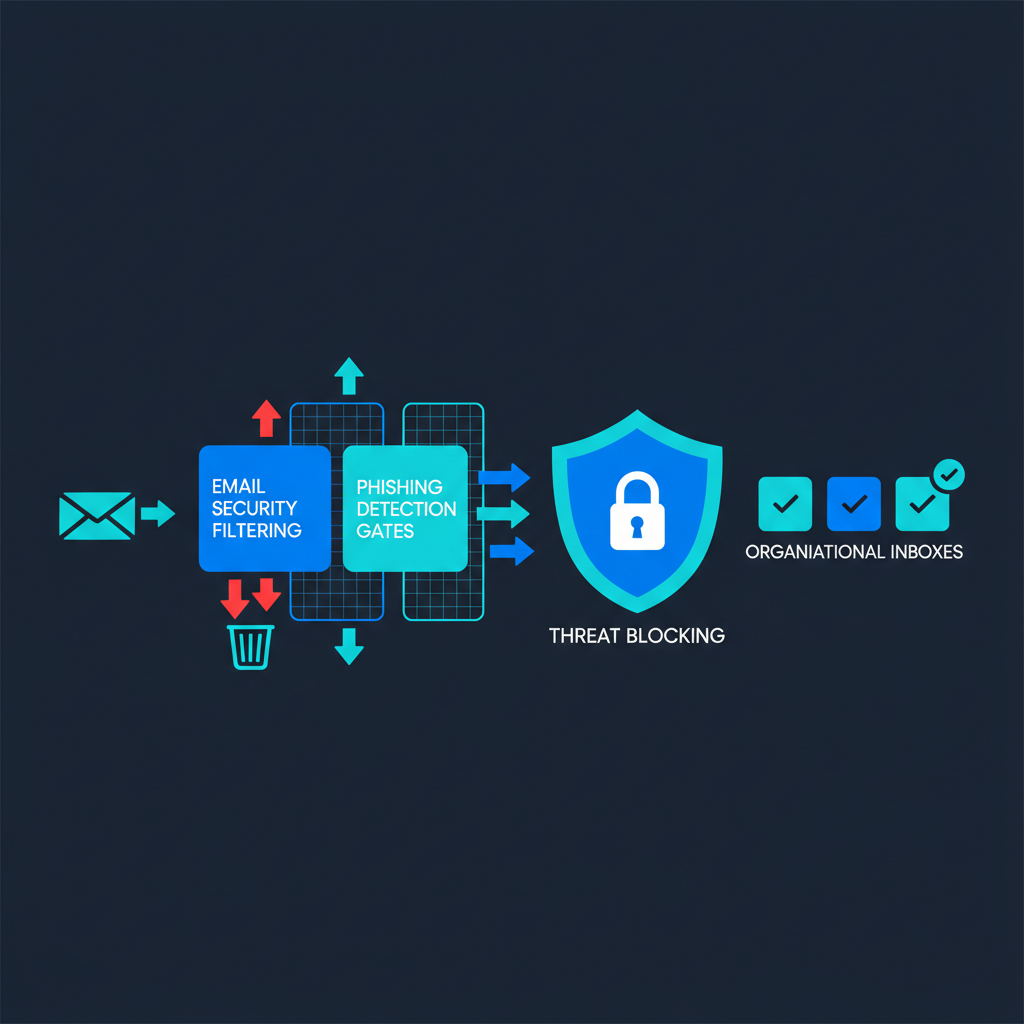
Why Email Remains the Primary Attack Vector
Email is still the most common entry point for phishing attacks targeting enterprise organisations.
Common Email Threats
- Credential harvesting emails
- Malicious attachments and QR codes
- Executive impersonation attacks
- Fake Microsoft login requests
- Business email compromise
Operational Challenges
- Delayed user reporting
- Manual, time-consuming investigations
- Fragmented response workflows
- Limited visibility into active campaigns
- Overloaded security teams
Even organisations with secure email gateways and Microsoft security controls face operational gaps. Wise Fish helps close them with Cofense-powered detection, reporting and response.
Email Filtering Alone Is Not Enough
Traditional email security focuses on preventing threats from reaching inboxes. Yet modern phishing attacks increasingly bypass preventative controls through compromised accounts, AI-generated content and sophisticated social engineering.
Organisations need visibility into threats that reach users, and the ability to investigate, validate and remediate them quickly. This creates a more resilient, post-perimeter defence strategy.
Modern email threat protection combines
User Reporting
AI Analysis
Human Validation
Campaign Detection
Threat Correlation
Threat Remediation
Incident Response
Continuous Improvement
Microsoft 365 Email Security Challenges
Microsoft 365 remains one of the most heavily targeted platforms for phishing campaigns. Attackers design threats specifically to compromise user accounts and business communications across Outlook, Teams and SharePoint.
Works alongside existing security
Cofense complements Microsoft Defender, Proofpoint, Mimecast and secure email gateways. Rather than replacing preventative controls, it helps teams identify, investigate and remediate threats that bypass traditional filtering.
Microsoft Defender
- Email filtering
- Malware detection
- URL protection
- Prevention
Cofense
- User reporting
- AI triage
- Campaign detection
- Threat intelligence
- Post-delivery response
Cofense complements Microsoft Defender by helping security teams investigate and respond to phishing attacks that successfully reach user inboxes.
Users regularly encounter:
- Fake Microsoft login pages
- Phishing attachments
- Impersonation emails
- Malicious SharePoint links
- Fraudulent Teams notifications
- MFA fatigue attacks
Cofense helps improve:
- Phishing reporting workflows
- Phishing investigations
- AI-powered phishing analysis
- Automated phishing response
- Outlook phishing reporting
- Threat correlation and campaign detection
AI-Powered Analysis and Human Validation
Modern email threat protection combines AI with human expertise. AI identifies suspicious patterns, prioritises investigations and detects related activity. Human validation adds context and confidence when assessing sophisticated attacks.
Together, they accelerate response while improving investigation quality and reducing analyst workload, integrating with SOC, SOAR and SIEM workflows.
Faster Threat Analysis
AI accelerates identification and prioritisation of suspicious emails.
Improved Accuracy
Human validation adds context to automated findings, reducing false positives.
Reduced Analyst Workload
Automation handles repetitive triage, freeing analysts for higher-priority incidents.
Better Campaign Visibility
Detect related activity and identify broader campaigns, not isolated emails.
More Confident Responses
Combining automation with expertise leads to faster, better decisions.
Post-Perimeter Defence
Address threats that reach inboxes despite preventative controls.
Improve Phishing Reporting and Threat Visibility
Rapid user reporting is critical for reducing response times and improving threat visibility. Modern reporting platforms do more than collect suspicious emails; they feed directly into intelligence, investigation and remediation workflows.
This transforms user reporting into a core component of your detection and response strategy, helping teams identify campaigns faster and accelerate containment.
Traditional Reporting
- Manual investigations
- Inconsistent user reporting
- Overloaded security teams
- Fragmented workflows
- Delayed threat visibility
Modern Reporting
- One-click Outlook reporting
- Structured triage workflows
- Investigation visibility
- Automated response triggers
- Campaign-level detection
Campaign Detection and Threat Visibility
Phishing-specific intelligence reveals emerging campaigns, attacker infrastructure and evolving techniques before they spread.
Traditional email security relies on historical indicators and preventative filtering. Phishing-specific intelligence, derived from real-world attacks reported globally, provides early visibility into emerging campaigns.
Combined with campaign detection and threat correlation, teams can identify related activity, understand attacker infrastructure and respond more effectively.
Campaign Detection
Identify related messages across the organisation as part of a broader campaign.
Threat Correlation
Group related activity to understand attacker infrastructure and scope.
Faster Investigations
Intelligence-driven context accelerates analysis and prioritisation.
Improved Visibility
Gain real-time awareness of active campaigns targeting your organisation.
Targeted Remediation
Intelligence informs more effective removal and containment actions.
Better Response Outcomes
Informed decisions reduce exposure and improve containment.
Reduce Email Threat Detection and Response Delays
Cofense-powered phishing response solutions help organisations improve operational phishing defence maturity.
Common response challenges:
- Overloaded investigation queues
- Repeated, manual threat handling
- Inconsistent response processes
- Limited operational visibility
Cofense helps teams:
- Automate triage and response workflows
- Accelerate investigations with AI
- Quarantine and contain threats faster
- Remediate campaigns at scale
- Strengthen SOC efficiency and resilience
Threat Remediation and Quarantine
When attacks bypass preventative controls, rapid remediation becomes critical. Teams need to locate, quarantine and remove malicious emails before additional users interact with them.
Modern remediation identifies related threats, quarantines content and removes campaigns at scale through automated workflows and analyst-assisted investigation.
Threat Detection
Validation
Campaign Detection
Mailbox Search
Threat Removal
Resolution
Threat Quarantine
Quarantine malicious messages rapidly to reduce exposure and limit campaign impact.
Campaign-Wide Remediation
Remove related threats across multiple users and departments simultaneously.
Mailbox Remediation
Locate and delete malicious emails from all affected inboxes at scale.
Automated Removal
Trigger automated actions to accelerate containment and reduce manual effort.
Faster Containment
Shorten the gap between detection and resolution to minimise dwell time.
Reduced Dwell Time
Rapid response limits the window for credential theft and compromise.
Supporting Organisations, MSPs and Security Teams
Wise Fish supports organisations, MSPs and enterprise security teams deploying Cofense-powered email threat protection and phishing response solutions.
We help organisations improve:
- Microsoft 365 phishing defence
- Reporting workflows
- Detection programmes
- Response processes
- Threat visibility
- Simulation training
What we provide:
- UK Cofense distribution and enablement
- Enterprise email security specialists
- Reporting and response consultancy
- Enterprise deployment support
- Dedicated MSP and reseller programmes
Email Threat Protection as Part of a Unified Phishing Defence Strategy
Filtering alone is not enough. Organisations increasingly adopt unified strategies that combine detection, campaign visibility, response and remediation.
Together, these capabilities improve visibility, accelerate response and strengthen resilience against evolving threats.