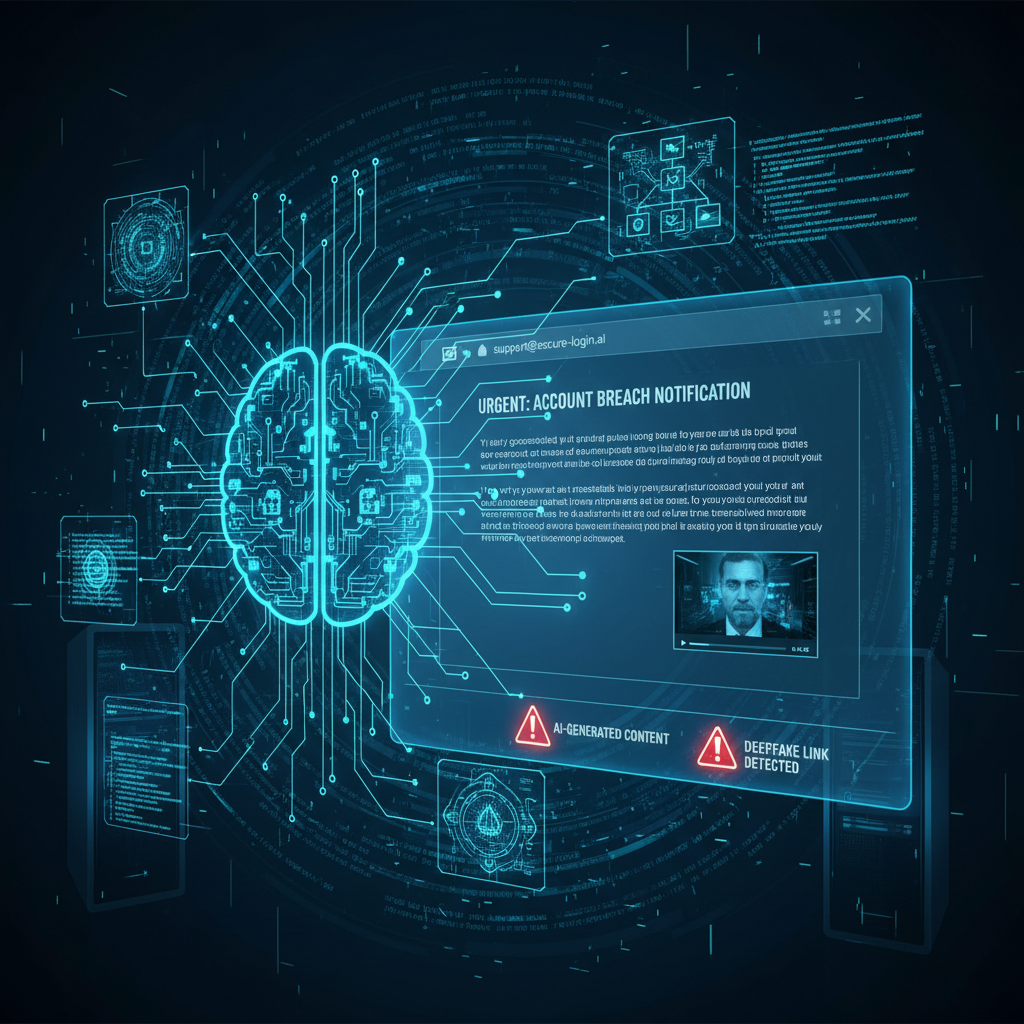
AI Phishing Attacks: How Artificial Intelligence Is Making Phishing More Dangerous Than Ever
AI-powered phishing can now generate highly convincing emails at scale, with no obvious warning signs. Discover how organisations detect and respond to artificial intelligence-generated phishing threats.
What Is AI Phishing?
AI phishing refers to phishing attacks that use artificial intelligence technologies to create, personalise or automate malicious communications designed to deceive victims.
Instead of manually writing phishing emails, attackers now use AI tools to generate large volumes of convincing content quickly and cheaply. This significantly increases both the scale and effectiveness of AI-powered social engineering attacks across email, cloud platforms and business communication environments.
AI enables attackers to create:
- Phishing emails
- SMS phishing messages
- Social media scams
- Executive impersonation messages
- Fake customer communications
- Business email compromise attacks
- Credential harvesting campaigns
How AI Is Changing Phishing Attacks
Traditional phishing campaigns often suffered from obvious flaws like poor grammar and spelling mistakes. AI removes these barriers, enabling attackers to generate messages that are indistinguishable from legitimate communications.
Grammatically Correct
Professional language increases credibility and passes basic content filters.
Highly Personalised
Messages can reference job roles, company names, industry terminology and recent events.
Contextually Relevant
AI creates messages tailored to specific business situations and victim profiles.
Multilingual
Attackers can target organisations globally without language barriers.
Mass Produced
Thousands of unique phishing emails can be generated within minutes.
AI Phishing Requires a Unified Defence Strategy
Artificial intelligence is making phishing attacks faster, more convincing and more difficult to detect.
As organisations adopt Microsoft Copilot and other workplace AI assistants, employees need to understand the difference between trusted business AI and malicious AI-generated communications designed to deceive them.
Modern organisations require more than awareness programmes and email filtering alone.
An effective defence strategy should combine:
- User Reporting
- Campaign Detection
- AI-Powered Analysis
- Human Validation
- Detection & Response
- Threat Remediation
- Human Risk Management
Together these capabilities help organisations identify, investigate and contain AI-generated phishing threats before they become incidents.
What Are AI Generated Phishing Emails?
AI-generated phishing emails are fraudulent messages created wholly or partially using artificial intelligence. Attackers may use AI to draft convincing messages, rewrite templates, mimic writing styles and personalise content.
Every message can be unique. This significantly reduces the effectiveness of traditional detection methods that rely on identifying repeated patterns.
Attackers use AI to:
- Draft convincing messages
- Rewrite existing templates
- Mimic writing styles
- Personalise content for victims
- Improve grammar and tone
- Create variations designed to bypass detection
How Criminals Use Generative AI for Phishing
Attackers increasingly use a variety of generative AI tools and large language models to create convincing phishing content. As these technologies evolve, criminals adapt new models and services to generate, personalise and scale phishing campaigns faster than ever before.
Threat actors use generative AI to:
- Generate phishing content
- Create impersonation attempts
- Produce convincing scam messages
- Research potential victims
- Automate attack preparation
The real risk is that generative AI lowers the barrier to entry for cyber criminals and allows sophisticated phishing techniques to be deployed at scale.
Real Example Of An AI Phishing Attack
From: james.wilson@company.co.uk
Subject: Updated contract for review
Hi Sarah,
Following our discussion at last week's supplier review meeting, could you please review the updated contract before close of business?
The revised version is available securely here.
Regards,
James
This message appears:
- Professional and well-written
- Relevant to the recipient's role
- Contextually accurate and timely
- Free from spelling or grammar mistakes
- No obvious warning signs
The link leads to a fake Microsoft 365 login page. This is exactly the type of attack that AI enables attackers to create quickly and at scale.
Nothing about the wording appears suspicious. The only malicious element is the destination behind the embedded link, demonstrating why AI-generated phishing is significantly harder to recognise.
Campaign Intelligence Helps Identify Emerging AI Campaigns
AI phishing campaigns evolve rapidly and often generate unique messages designed to evade traditional detection methods.
Phishing-specific campaign intelligence helps organisations:
- Identify Active Campaigns
- Detect Emerging Attack Techniques
- Monitor Credential Theft Activity
- Understand Attacker Behaviour
- Improve Investigation Context
- Accelerate Response Activities
Real-world phishing intelligence derived from millions of user-reported phishing emails provides early visibility into emerging AI-generated phishing campaigns before they become widespread.
Campaign Intelligence Capabilities
- Identify Active Campaigns
- Detect Emerging Techniques
- Monitor Credential Theft
- Understand Behaviour
- Improve Context
- Accelerate Response
Why AI Phishing Detection Is More Difficult
Traditional phishing detection often relies on identifying known indicators. AI-generated attacks challenge these methods in several ways.
Every Message Can Be Unique
There may be no identical samples for detection systems to compare, making signature-based detection ineffective.
Language Quality Is Higher
Traditional grammar-based warning signs disappear, making messages harder to distinguish from legitimate communications.
Personalisation Is Easier
Attackers can tailor messages to individual recipients with contextual accuracy, increasing success rates.
Campaigns Evolve Rapidly
AI allows attackers to modify content continuously, adapting to new defences in real-time.
As a result, organisations increasingly require a combination of campaign intelligence, campaign detection, automated analysis and rapid response capabilities.
The AI Phishing Defence Workflow
A connected pathway from AI-generated email to organisation protected.
- Step 1
AI Generates Email
- Step 2
Employee Reports Suspicious Email
- Step 3
AI Investigation
- Step 4
Campaign Detection
- Step 5
Threat Quarantine
- Step 6
Organisation Protected
AI-Powered Business Email Compromise
Business Email Compromise remains one of the most financially damaging forms of phishing.
The FBI's 2024 Internet Crime Report recorded $2.77 billion in Business Email Compromise losses across 21,442 incidents.
Artificial intelligence enables attackers to:
- Mimic Executive Writing Styles
- Generate Contextually Relevant Messages
- Personalise Fraud Attempts
- Improve Executive Impersonation
- Increase Payment Fraud Success Rates
AI-enhanced BEC attacks represent a growing threat to organisations of all sizes.
BEC Attack Indicators
- Requests for Urgent Payments
- Executive Tone and Style
- Time Pressure Tactics
- Unusual Request Routing
- Contextual Accuracy
- Professional Language
Common Types Of AI Phishing Attacks
Executive Impersonation
AI-enhanced impersonation attacks target senior executives using highly convincing communications.
Explore whaling phishing attacksAI-Generated Spear Phishing
Highly personalised messages designed for specific individuals using AI research and customisation.
Read spear phishing guideAI-Driven SMS Phishing
Artificial intelligence used to generate convincing smishing campaigns with personalised content.
Explore smishing attacksAI-Assisted QR Code Phishing
Attackers create realistic messages encouraging users to scan malicious QR codes.
Learn about quishingAI-Enhanced Credential Harvesting
Fake login pages and phishing campaigns generated and personalised using artificial intelligence.
See phishing examplesHow Cofense Delivers Unified Defence Against AI Phishing
User Reporting
Employees identify suspicious messages and provide valuable threat signals that feed into investigation and response workflows.
Campaign Intelligence
Real-world phishing intelligence provides context on active campaigns and emerging attacker techniques targeting your industry.
AI-Assisted Investigation
Automated analysis accelerates investigation and threat validation while humans provide contextual judgement and decision-making.
Campaign Detection
Threat clustering identifies broader attacks affecting multiple users and identifies attack infrastructure and patterns.
Threat Remediation
Malicious emails can be identified, contained and removed rapidly from inboxes before users open them.
Human Risk Reduction
Awareness programmes, simulations and behavioural analytics strengthen organisational resilience against sophisticated attacks.
Together these capabilities create a unified phishing defence strategy positioned as an integrated capability rather than individual products.
Detecting AI Phishing Is Only The First Step
Identifying a phishing email does not eliminate risk.
Effective phishing defence should include:
- Threat Quarantine
- Automated Email Removal
- Campaign-Wide Remediation
- Threat Containment
- Incident Response
- Reduced Attacker Dwell Time
Modern organisations require the ability to remove threats as quickly as they can detect them.
Response Capabilities
- Threat Quarantine
- Email Removal
- Campaign Remediation
- Threat Containment
- Response Automation
- Reduce Dwell Time
Employee Reporting Creates Valuable Threat Intelligence
Employees frequently identify suspicious emails before automated systems detect them.
User-reported phishing emails provide:
- Campaign Intelligence
- Investigation Context
- Campaign Visibility
- Detection Opportunities
- Early Warning Signals
Reporting becomes significantly more valuable when integrated into investigation and response workflows.
Reporting Benefits
- Valuable Intelligence
- Investigation Context
- Campaign Visibility
- Detection Signals
- Early Warnings
- Response Capability
Why Human Detection Still Matters
Artificial intelligence may improve phishing attacks. However, attackers still rely on human behaviour to succeed. People notice things technology often cannot.
Effective human detection requires:
- Behavioural Analysis
- Human Risk Indicators
- Reporting Behaviour Trends
- Contextual Judgement
- Organisational Knowledge
Employees are an active component of phishing defence rather than passive recipients of training.
Employees Recognise
- Unusual Requests
- Pressure Tactics
- Style Inconsistencies
- Suspicious Patterns
- Contextual Anomalies
- Business Logic Gaps
Why Existing Security Controls Are Not Enough
Most organisations already deploy security technologies including Microsoft Defender, secure email gateways, endpoint protection, identity security and multi-factor authentication.
Despite these investments, AI-generated phishing attacks continue to bypass preventative controls because they exploit human trust and behaviour.
Cofense complements existing security investments by improving visibility, investigation, detection and remediation capabilities.
Typical Existing Investments
- Microsoft Defender
- Secure Email Gateways
- Endpoint Protection
- Identity Security
- Multi-Factor Authentication
- SOC Services
- SOAR and SIEM Platforms
- DMARC and Zero Trust Controls
How To Protect Your Organisation Against AI Phishing
A comprehensive approach combining threat intelligence, detection, response and human risk management provides the strongest defence.
Campaign Intelligence
Real-world phishing intelligence provides visibility into active campaigns and emerging attack techniques.
Phishing Detection and Response
Automated detection combined with human validation accelerates threat identification and investigation.
Threat Remediation
Rapid removal of malicious emails reduces exposure and minimises attacker dwell time in inboxes.
Human Risk Management
Behavioural analytics and risk scoring help organisations understand and reduce human cyber risk.
Behavioural Analytics
Monitor reporting behaviour trends and identify high-risk users requiring additional support.
Continuous Monitoring
Threat landscapes evolve rapidly. Organisations require ongoing threat intelligence and campaign tracking.
Understanding Human Risk in the Age of AI
As phishing attacks become increasingly sophisticated, organisations require greater visibility into human cyber risk.
Human Risk Management helps organisations understand:
- Reporting Behaviour
- Phishing Susceptibility
- High-Risk Users
- Department Risk Trends
- Behavioural Improvement
- Security Culture Maturity
Human Risk Management enables organisations to reduce risk proactively rather than reactively.
Key Risk Metrics
- Reporting Behaviour
- Phishing Click Rates
- High-Risk Users
- Department Trends
- Culture Maturity
- Risk Improvement
The Future Of AI Phishing
AI phishing is likely to become more personalised, more convincing and faster to deploy. Organisations must stay ahead of evolving threats.
Future AI phishing will likely become:
- More personalised to individual targets
- More convincing and realistic
- Faster to deploy at scale
- More difficult to detect with technology alone
Future attacks may incorporate:
- Voice cloning technology
- Deepfake video creation
- Real-time impersonation
- Automated social engineering
- Adaptive phishing campaigns
The organisations most resilient to these threats will be those that combine advanced technology with educated, vigilant employees.
The Future of AI-Powered Phishing Defence
Just as attackers are adopting artificial intelligence, defenders are using AI to improve detection, investigation and response.
Future phishing defence will increasingly combine:
- AI-Assisted Detection
- Automated Investigations
- Campaign Intelligence
- Human Validation
- Behavioural Analytics
- Campaign Correlation
The most effective organisations will combine technology and human expertise to build long-term resilience.
Defence Capabilities
- AI Detection
- Automated Triage
- Behavioural Analytics
- Campaign Tracking
- Threat Correlation
- Rapid Response
How WiseFish Helps Organisations Defend Against AI Phishing
WiseFish delivers unified AI phishing defence combining threat intelligence, detection, response and human risk management powered by Cofense.
Why organisations choose us:
- UK Cofense Authorised Distributor
- Enterprise phishing defence expertise
- Microsoft 365 and cloud security experience
- Threat intelligence experience
- Consultancy-led approach
- Long-term customer success
Outcomes you receive:
- Faster phishing investigations
- Reduced attacker dwell time
- Improved phishing visibility
- Stronger organisational resilience
- Lower human cyber risk
- Improved operational maturity
AI Phishing and Microsoft 365
AI-generated phishing increasingly targets trusted Microsoft collaboration services, including Outlook, Exchange Online, Microsoft Teams, SharePoint, OneDrive and Microsoft Entra ID, to steal credentials, gain access to cloud resources and move laterally within organisations.
While many organisations operate Microsoft 365 environments, AI phishing attacks also target Google Workspace and other cloud collaboration platforms. Effective defence spans all modern communication environments.
Building A Unified Defence Against AI Phishing
Artificial intelligence is fundamentally changing how phishing attacks are created and delivered.
Effective protection requires more than awareness programmes alone.
Modern phishing defence combines:
Business Outcomes
- Faster phishing investigations
- Reduced attacker dwell time
- Improved phishing visibility
- Stronger organisational resilience
- Lower human cyber risk
- Faster response and remediation
- Improved operational maturity
These outcomes help organisations respond more effectively to AI-generated phishing attacks.
AI Phishing FAQs
UK Cofense Authorised Distributor
Authorised Cofense distribution for UK organisations.
AI Phishing Specialists
Dedicated expertise in generative AI phishing defence.
Microsoft 365 Experts
Deep Microsoft 365 phishing protection experience.
Human Risk Specialists
Behavioural analytics and human risk management.
Enterprise Deployment Experience
Large-scale Cofense rollout and support.
UK & European Support
Local support across the UK and Europe.