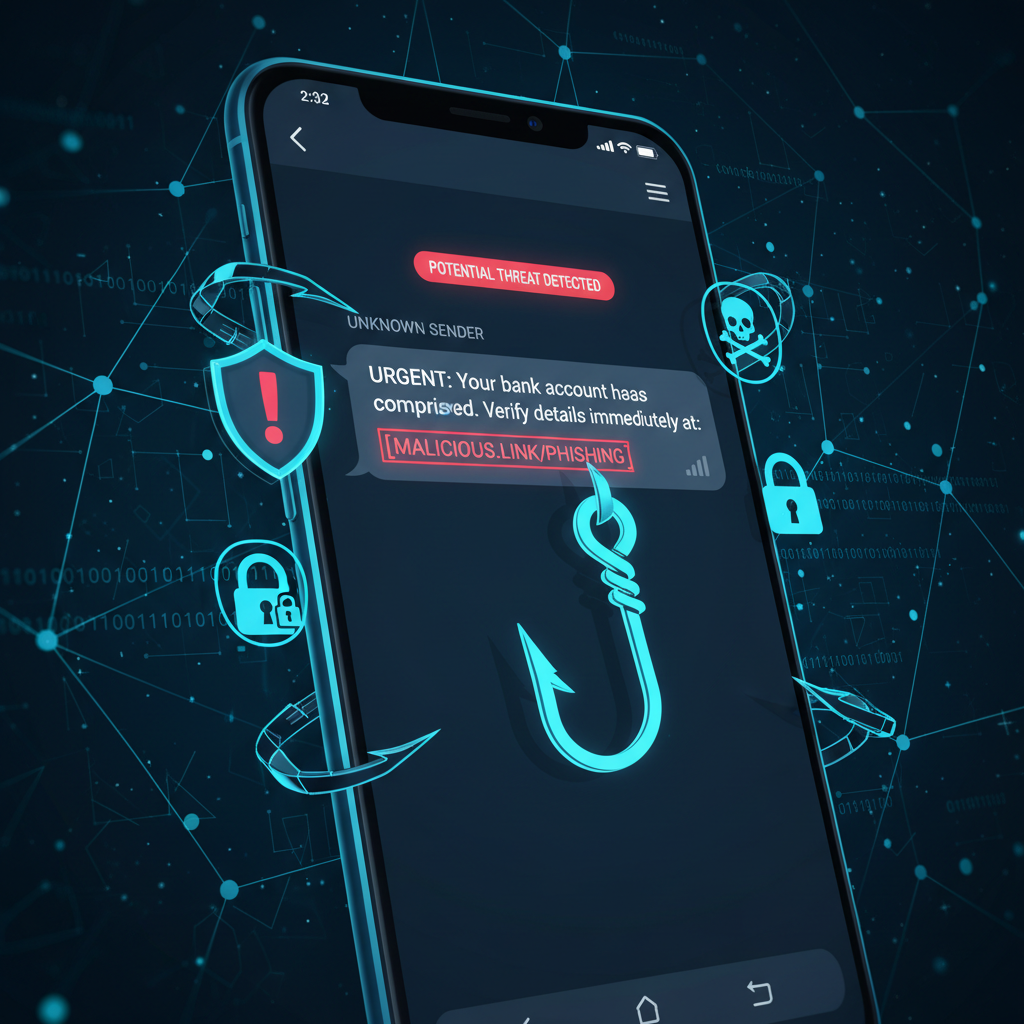
What Is Smishing?
Smishing, also known as text message phishing, is a form of phishing attack that uses SMS text messages instead of email to deceive victims.
The term combines SMS + Phishing = Smishing. Attackers send fraudulent text messages designed to trick recipients into revealing credentials, installing malware or transferring money.
Attackers trick victims into:
- Clicking malicious links
- Downloading malware
- Revealing passwords
- Sharing personal information
- Approving fraudulent payments
- Installing malicious applications
Why Smishing Attacks Are Increasing
Traditional phishing attacks increasingly face email filtering, security awareness programmes and secure email gateways. To bypass these controls, attackers have shifted towards mobile channels where security is often weaker.
Text messages often:
- Appear more trustworthy than email
- Create a sense of urgency
- Reach users instantly
- Avoid traditional email security controls
- Encourage immediate action without verification
SMS phishing has become one of the fastest-growing cyber threats facing organisations today.
While this page focuses on SMS phishing, attackers increasingly use additional mobile messaging platforms including WhatsApp, Signal, Telegram, iMessage and RCS messaging. The same social engineering techniques are now commonly used across modern messaging platforms, not just traditional text messages.
How A Smishing Attack Works
Smishing attacks follow a predictable pattern that exploits employee trust and urgency.
Step 1
Delivery
The victim receives a text message appearing to originate from a bank, HMRC, Royal Mail, DHL, Microsoft, Amazon or internal IT support.
Step 2
Urgency
The message creates pressure with account suspension warnings, failed deliveries, security alerts or unpaid invoice notifications.
Step 3
Action
The victim is encouraged to click a link, call a phone number, install an application or log in to an account.
Step 4
Compromise
Credentials, financial details or sensitive information are stolen. Attackers may then access corporate accounts, conduct phishing or commit fraud.
Common Smishing Scams and Examples
Parcel Delivery Scam
Royal Mail: Your parcel could not be delivered. Please arrange redelivery here: [Malicious Link]
Outcome: The website requests payment details.
Banking Alert Scam
Your account has been temporarily restricted. Verify your details immediately to avoid suspension.
Outcome: The victim is directed to a fake banking website.
Microsoft 365 Login Scam
Unusual activity detected on your Microsoft account. Verify your identity now.
Outcome: The link leads to a fake login page designed to harvest credentials.
HMRC Tax Refund Scam
You are eligible for a tax refund of £467. Claim your refund today.
Outcome: The attacker steals personal and banking information.
Executive Impersonation Scam
Hi Sarah. Can you urgently purchase gift cards for a client meeting? I am currently unavailable.
Outcome: The sender impersonates a senior executive, combining smishing with BEC.
None of these messages rely on poor spelling or obvious mistakes. Their success depends on urgency, trust and mobile-first behaviour rather than technical sophistication.
Warning Signs Of A Smishing Attack
Employees should look for:
Unexpected Messages
Texts from organisations you were not expecting to hear from.
Urgent Requests
Messages demanding immediate action without time for verification.
Suspicious Links
Shortened URLs or unfamiliar domains that don't match the sender.
Requests For Credentials
Legitimate organisations rarely ask for passwords via SMS.
Payment Requests
Unexpected requests involving payments, gift cards or banking information.
Poor Grammar
Language inconsistencies or unusual phrasing for the supposed sender.
How Smishing Impacts Organisations
Business users increasingly access Outlook Mobile, Exchange Online, Microsoft Teams, Microsoft Authenticator and Microsoft Entra ID through mobile devices. Successful smishing attacks frequently result in compromised Microsoft 365 credentials, enabling attackers to access cloud services and move laterally across enterprise environments.
The FBI's 2025 Internet Crime Report recorded 241,342 phishing complaints, including vishing, smishing and pharming, the highest of any cybercrime category.
Data Breaches
Attackers gain access to confidential information and sensitive business data.
Financial Loss
Fraudulent payments or business email compromise attacks targeting finance teams.
Account Takeovers
Corporate accounts become compromised and used for wider attacks, generating IOCs that signal broader campaign activity.
Operational Disruption
Critical systems and services may be affected by malware or unauthorised access.
Reputational Damage
Customer trust can be significantly impacted by security incidents.
How Organisations Can Prevent Smishing Attacks
No single control can eliminate the risk completely. A layered approach provides the strongest protection.
Phishing Defence Training
Employees should understand how smishing works, common techniques and mobile phishing risks. Regular training significantly improves detection rates.
Multi-Factor Authentication (MFA)
Even if credentials are stolen via smishing, MFA provides an additional security layer preventing account takeover.
Zero Trust and DMARC Controls
Zero Trust principles and DMARC email authentication reduce the blast radius of compromised credentials harvested via smishing.
Mobile Device Security
Implement mobile device management, application controls, security monitoring and device compliance policies.
Verification Procedures
Users should verify suspicious requests through trusted channels before taking any action.
Phishing Reporting Processes
Employees should know how to report suspicious text messages quickly. Rapid reporting improves detection.
How Cofense Helps Combat Smishing Threats
While Cofense specialises in phishing defence across enterprise environments, the same human-centred reporting, investigation and response principles also help organisations defend against SMS phishing and other social engineering attacks.
Build A Security-Aware Workforce
Employees become active participants in threat detection and reporting.
Improve Reporting Behaviour
Users learn to recognise and report suspicious activity, including smishing, quickly.
Accelerate Threat Investigation
Security teams gain visibility into phishing activity before wider compromise occurs, integrating with SOC, SOAR and SIEM workflows.
Strengthen Incident Response
Reported threats can be investigated, prioritised and remediated more effectively.
Reduce Human Risk
Continuous awareness programmes help employees identify evolving attack techniques across all channels.
The Smishing Defence Workflow
A connected pathway from suspicious SMS to organisation protected.
- Step 1
SMS Received
- Step 2
Employee Reports Suspicious Message
- Step 3
AI Investigation
- Step 4
Campaign Detection
- Step 5
Threat Quarantine
- Step 6
Organisation Protected
How WiseFish Helps Organisations Reduce Smishing Risk
WiseFish helps organisations improve resilience against phishing and social engineering threats across all communication channels.
Why organisations choose us:
- UK Cofense Authorised Distributor
- Enterprise phishing defence expertise
- Microsoft 365 and cloud security experience
- Threat intelligence experience
- Consultancy-led approach
- Long-term customer success
Outcomes you receive:
- Faster phishing investigations
- Reduced attacker dwell time
- Stronger mobile threat visibility
- Improved workforce resilience
- Lower employee cyber risk
- Improved operational maturity
Smishing FAQs
UK Cofense Authorised Distributor
Authorised Cofense distribution for UK organisations.
Mobile Phishing Specialists
Dedicated expertise in SMS and mobile phishing defence.
Microsoft 365 Experts
Deep Microsoft 365 phishing protection experience.
Human Risk Specialists
Behavioural analytics and human risk management.
Enterprise Deployment Experience
Large-scale Cofense rollout and support.
UK & European Support
Local support across the UK and Europe.