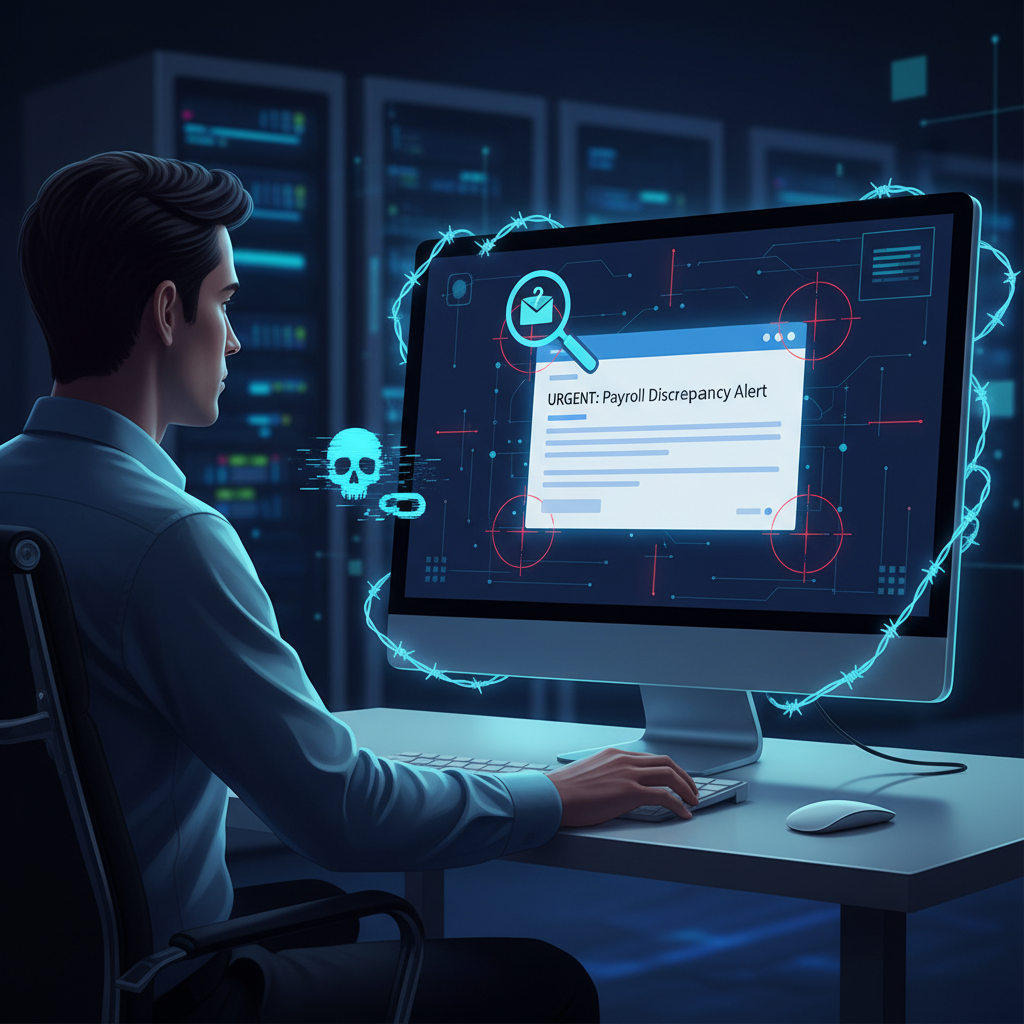
What Is Spear Phishing?
Spear phishing is a targeted phishing attack aimed at a specific individual, department or organisation.
Unlike traditional phishing campaigns sent to thousands of recipients, spear phishing messages are customised using information gathered from open sources.
Information gathered from:
- LinkedIn profiles
- Company websites
- Social media accounts
- Public records
- Previous data breaches
Attackers often impersonate:
- Managing directors
- Finance teams
- Suppliers
- HR departments
- IT support teams
- Trusted business partners
Why Spear Phishing Is So Dangerous
Traditional phishing relies on volume. Spear phishing relies on credibility.
Attackers may spend days or weeks researching targets before launching an attack.
Spear Phishing Requires a Unified Defence Strategy
Modern spear phishing attacks are highly targeted, personalised and increasingly capable of bypassing traditional security controls.
Organisations require more than awareness programmes and email filtering alone.
An effective defence strategy should combine:
- User Reporting
- Campaign Detection
- AI-Powered Analysis
- Human Validation
- Detection & Response
- Threat Remediation
- Human Risk Management
Together these capabilities help organisations identify, investigate and contain targeted phishing attacks before they result in compromise.
Real-World Spear Phishing Example
Imagine receiving the following email:
From: james.wilson@companyltd.co.uk
Subject: Supplier contract, board meeting today
Hi Sarah,
Could you urgently review the attached supplier contract before today's board meeting?
Thanks,
James
At first glance it appears normal. However:
- The sender domain is slightly altered
- The attachment contains malware
- The message creates urgency
- The sender is impersonating a genuine colleague
Every element of the email appears legitimate. The attack succeeds because it exploits business context, familiarity and urgency rather than technical vulnerabilities.
How To Identify Spear Phishing Emails
Warning signs to look for:
Unexpected Requests
Requests involving passwords, payment changes, bank details or sensitive information.
Urgency
Messages demanding immediate action.
Domain Spoofing
Addresses that appear legitimate but contain subtle spelling differences.
Suspicious Links
URLs that redirect to fake login pages.
Unusual Behaviour
Messages that feel out of character for the sender.
How Artificial Intelligence Is Changing Spear Phishing
Artificial intelligence is transforming spear phishing by allowing attackers to create highly convincing, personalised communications at scale.
The FBI's 2024 Internet Crime Report recorded $2.77 billion in Business Email Compromise losses, making BEC one of the costliest cybercrime categories reported.
Attackers increasingly use AI to:
- Mimic Executive Writing Styles
- Personalise Messages
- Research Targets
- Generate Convincing Business Communications
- Improve Social Engineering
- Automate Campaign Creation
AI-powered spear phishing combines personalisation with scale, making attacks harder to identify using traditional methods.
AI-Enhanced Capabilities
- Style Mimicry
- Personalisation at Scale
- Target Research
- Message Variation
- Social Engineering
- Campaign Automation
Campaign Intelligence Helps Identify Emerging Spear Phishing Campaigns
Targeted phishing campaigns evolve rapidly and often use new domains, compromised accounts and previously unseen infrastructure.
Phishing-specific campaign intelligence helps organisations:
- Identify Active Campaigns
- Detect Emerging Attack Techniques
- Monitor Credential Theft Activity
- Understand Attacker Behaviour
- Improve Investigation Context
- Accelerate Response Activities
Real-world phishing intelligence derived from millions of user-reported phishing emails provides early visibility into targeted spear phishing campaigns before they spread across organisations.
Campaign Intelligence Benefits
- Campaign Identification
- Emerging Techniques
- Credential Monitoring
- Attacker Insight
- Investigation Context
- Response Acceleration
The Spear Phishing Defence Workflow
A connected pathway from targeted email to organisation protected.
- Step 1
Targeted Email Sent
- Step 2
Employee Reports Suspicious Email
- Step 3
AI Investigation
- Step 4
Campaign Detection
- Step 5
Threat Quarantine
- Step 6
Organisation Protected
Why Traditional Email Security Is Not Enough
Modern spear phishing campaigns increasingly bypass perimeter controls. Organisations require detection and response capabilities to address threats after delivery.
Most organisations already deploy:
- Microsoft Defender
- Secure Email Gateways
- Endpoint Protection
- Identity Security
- Multi-Factor Authentication
- SOC Services
- SOAR and SIEM Platforms
- DMARC and Zero Trust Controls
Despite these investments:
Spear phishing attacks continue to succeed because they exploit trust, authority and business context rather than technical vulnerabilities alone.
Modern spear phishing campaigns increasingly target trusted Microsoft collaboration services such as Outlook, Exchange Online, Microsoft Teams, SharePoint, OneDrive and Microsoft Entra ID to gain privileged access, compromise executive communications and move laterally throughout Microsoft 365 environments.
Cofense complements existing security investments through improved visibility, investigation, detection and remediation capabilities.
Detecting Spear Phishing Is Only The First Step
Identifying a spear phishing email does not eliminate risk.
Effective phishing defence should include:
- Threat Quarantine
- Automated Email Removal
- Campaign-Wide Remediation
- Threat Containment
- Incident Response
- Reduced Attacker Dwell Time
Modern organisations require the ability to remove threats as quickly as they can detect them.
Response Capabilities
- Threat Quarantine
- Email Removal
- Campaign Remediation
- Threat Containment
- Response Automation
- Reduce Dwell Time
Employee Reporting Creates Valuable Campaign Intelligence
Employees frequently identify suspicious emails before automated systems detect them.
User-reported messages provide:
- Campaign Intelligence
- Investigation Context
- Campaign Visibility
- Detection Opportunities
- Early Warning Signals
Reporting becomes significantly more valuable when integrated into investigation and response workflows.
Reporting Benefits
- Valuable Intelligence
- Investigation Context
- Campaign Visibility
- Detection Signals
- Early Warnings
- Response Capability
How Security Teams Improve Spear Phishing Detection
Modern organisations increasingly combine technology and human reporting. Platforms such as Cofense Triage automate investigation and prioritisation of user-reported phishing emails, helping analysts identify spear phishing campaigns and respond faster.
Employee Reporting
Users report suspicious emails using one-click reporting tools directly in Outlook.
Campaign Intelligence
Active phishing intelligence helps analysts understand attacker behaviour and campaign infrastructure.
Campaign Detection
Related attacks can be clustered and correlated to reveal wider campaigns targeting multiple users.
Threat Remediation
Confirmed threats can be rapidly identified and removed from affected mailboxes.
Combining AI and Human Expertise
Modern phishing defence increasingly combines automated analysis with human expertise.
AI helps security teams:
- Analyse Messages Faster
- Identify Threat Patterns
- Accelerate Investigations
Human analysts provide:
- Contextual Understanding
- Intent Validation
- Risk Assessment
- Decision-Making Expertise
The combination of AI and human validation improves detection accuracy and response effectiveness.
Understanding Human Risk and Spear Phishing
Targeted phishing attacks exploit human behaviour as much as technical weaknesses.
Human Risk Management helps organisations understand:
- Reporting Behaviour
- Phishing Susceptibility
- High-Risk Users
- Department Risk Trends
- Behavioural Improvement
- Security Culture Maturity
Human Risk Management enables organisations to reduce risk proactively rather than reactively.
Key Risk Metrics
- Reporting Behaviour
- Phishing Click Rates
- High-Risk Users
- Department Trends
- Culture Maturity
- Risk Improvement
Why Executives Are Prime Targets
Executives are frequently targeted because they possess authority, access to sensitive information and influence over financial decisions.
Attackers often spend days or weeks researching senior staff using publicly available information from LinkedIn, company websites, press releases, corporate biographies, social media and public filings. This research allows them to produce highly personalised phishing emails that closely resemble genuine business communications.
Common attacks include:
- CEO Fraud
- Executive Impersonation
- Business Email Compromise
- Financial Authorisation Fraud
- Supplier Payment Redirection
- Credential Theft
Executive risk should form part of every phishing defence strategy.
Executive Protection Strategy
Executive-targeted spear phishing requires dedicated detection and response capabilities alongside broader organisational phishing defence.
- Campaign Intelligence
- Campaign Detection
- Rapid Response
- Human Risk Monitoring
- Incident Response
- Resilience Building
How Cofense Delivers Unified Spear Phishing Defence
User Reporting
Employees provide valuable threat signals through rapid reporting.
Campaign Intelligence
Real-world phishing intelligence provides visibility into active campaigns and emerging attacker techniques.
AI-Assisted Investigation
Automated analysis accelerates investigation and threat validation.
Campaign Detection
Threat clustering identifies broader attacks affecting multiple users.
Threat Remediation
Malicious emails can be identified, contained and removed rapidly.
Human Risk Reduction
Awareness programmes, simulations and behavioural improvements strengthen resilience over time.
Together these capabilities create a unified phishing defence strategy positioned as an integrated capability rather than individual products.
The Future of Spear Phishing
Spear phishing attacks are becoming increasingly sophisticated through artificial intelligence.
Future attacks may incorporate:
- AI-Generated Content
- Executive Impersonation
- Deepfake Technologies
- Voice Cloning
- Automated Target Research
- Hyper-Personalised Messaging
Organisations will increasingly require:
Campaign intelligence, rapid detection and coordinated response capabilities to defend against evolving spear phishing attacks.
- Campaign Intelligence
- Rapid Detection
- Campaign Visibility
- Fast Response
- Human Risk Management
- Continuous Improvement
Building a Unified Defence Against Spear Phishing
Spear phishing attacks increasingly bypass traditional security controls and exploit employee trust, authority and business processes.
Effective protection requires more than awareness programmes alone.
Modern phishing defence combines:
Business Outcomes
- Faster phishing investigations
- Reduced attacker dwell time
- Stronger threat visibility
- Improved workforce resilience
- Lower employee cyber risk
- Faster response and remediation
- Improved operational maturity
These outcomes help organisations respond more effectively to targeted phishing attacks.
Spear Phishing FAQs
UK Cofense Authorised Distributor
Authorised Cofense distribution for UK organisations.
Spear Phishing Specialists
Dedicated expertise in targeted phishing defence.
Microsoft 365 Experts
Deep Microsoft 365 phishing protection experience.
Executive Protection Specialists
Targeted defence for high-risk senior staff.
Enterprise Deployment Experience
Large-scale Cofense rollout and support.
UK & European Support
Local support across the UK and Europe.