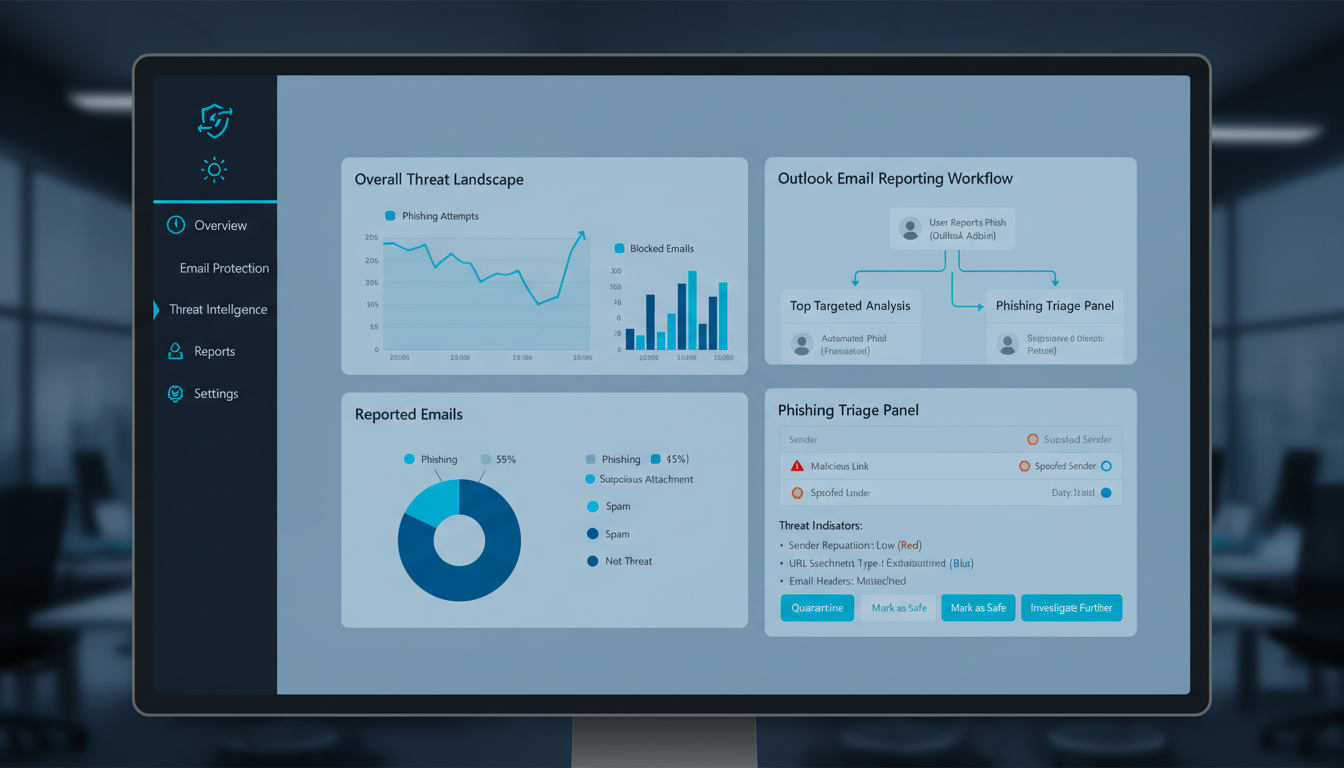
Why Security Awareness Matters
Technical controls cannot stop every phishing attack. When threats reach inboxes, employee behaviour determines whether they are reported, ignored or clicked.
Modern Phishing Threats
- AI-generated phishing content
- Deepfake social engineering
- Personalised campaigns
- Multi-channel attacks
- QR phishing and smishing
- Business email compromise
Why Awareness Alone Isn't Enough
- Delayed or inconsistent reporting
- Risky user behaviour
- Weak security culture
- Compliance-driven, not behaviour-driven
- Limited cyber awareness education
How Cofense Helps
Cofense-powered programmes strengthen employee behaviour and connect reporting into the global intelligence network.
Improves reporting rates
More employees report suspicious emails consistently and accurately.
Strengthens SOC and SOAR visibility
Security teams gain real-time visibility of active phishing campaigns.
Reduces risky user actions
Fewer clicks, credential disclosures and risky decisions across the workforce.
Accelerates detection
Reported threats are analysed and triaged faster, shortening response times.
Supports response workflows
Awareness feeds directly into detection, investigation and remediation.
Builds organisational resilience
Sustained training creates a stronger, more adaptable security culture.
Human Risk Management: Measuring What Matters
Leading organisations measure phishing risk through reporting behaviour, risky user actions and behavioural trends, rather than relying only on training completion rates. Awareness is one component of a wider human risk strategy, not a standalone product.
Human risk analytics focus on
Reporting Behaviour
Measure how consistently employees report suspicious emails.
Risky User Actions
Identify employees whose behaviour creates exposure.
Risk Trends
Track behavioural indicators over time to measure effectiveness.
High-Risk Users
Pinpoint individuals or departments needing targeted support.
Awareness Programmes for Microsoft 365
Cofense-powered awareness programmes strengthen Microsoft 365 defence through one-click Outlook reporting, intelligence-led simulations and behavioural analytics. Training supports operational detection and response rather than operating as a separate compliance exercise.
Awareness closes gaps in:
- Reporting behaviour
- Credential protection
- Threat visibility
- Detection workflows
- Human risk management
- Operational maturity
Programmes focus on:
- One-click Outlook reporting
- Intelligence-driven campaigns
- Multi-channel simulations
- Behavioural analytics
- Executive awareness training
- Departmental targeting
The Intelligence Feedback Loop
When employees report suspicious emails, organisations gain visibility into active campaigns. Reported threats feed into the global intelligence network as live, human-verified intelligence, improving detection and accelerating investigations.
Multi-Channel Simulations
Employees learn to recognise phishing across email, SMS, QR and social engineering channels.
One-Click Reporting
One-click reporting makes it easy to flag suspicious messages into live intelligence.
Live Intelligence
Reported emails feed human-verified intelligence, improving campaign detection.
AI-Powered Detection
Intelligence informs AI detection of related phishing activity.
Automated Response
Security teams triage, autoquarantine and remove threats efficiently.
Improved Resilience
Each cycle strengthens phishing resilience and reduces human risk.
Multi-Channel Simulations
Employees learn to recognise phishing across email, SMS, QR and social engineering channels.
One-Click Reporting
One-click reporting makes it easy to flag suspicious messages into live intelligence.
Live Intelligence
Reported emails feed human-verified intelligence, improving campaign detection.
AI-Powered Detection
Intelligence informs AI detection of related phishing activity.
Automated Response
Security teams triage, autoquarantine and remove threats efficiently.
Improved Resilience
Each cycle strengthens phishing resilience and reduces human risk.
Build a Security-Aware Culture
Sustainable awareness programmes adapt to current threats, target higher-risk groups and measure reporting behaviour over time. The objective is not course completion; it is measurable improvement in real-world security decisions.
Cofense delivers:
- One-click Outlook reporting
- Human risk measurement
- Behavioural analytics
- Multi-channel simulations
- IOC-driven campaigns
- Executive awareness training
Outcomes include:
- Stronger reporting behaviour
- Improved employee engagement
- Reduced risky user actions
- Sustained behavioural change
- Greater organisational resilience
- Security-first culture
Measure Awareness Through Phishing Simulations
Phishing simulations provide measurable evidence of how employees respond to realistic threats across email, QR, SMS and social engineering channels.
Simulation types:
- Email phishing simulations
- QR phishing and smishing
- BEC scenarios
- Multi-channel social engineering
- Executive-targeted exercises
Analytics measure:
- Click and reporting rates
- User risk levels
- Departmental trends
- Behavioural improvement over time
- Human risk reduction
Security Awareness as Part of a Unified Phishing Defence Strategy
Security awareness training delivers the greatest value when integrated with reporting, detection and remediation.
Together, these capabilities create a continuous defence cycle that strengthens resilience across Microsoft 365 and other enterprise environments. Awareness is operational defence rather than compliance.
Supporting Enterprise Organisations, MSPs and Security Teams
Why organisations choose Wise Fish:
- UK Cofense authorised distributor
- Enterprise deployment experience
- Consultative, outcome-focused approach
- Measurable programme improvement
- Dedicated MSP and reseller enablement
- Microsoft 365 integration expertise
What we provide:
- Programme design and strategy
- Simulation campaign management
- Behavioural analytics and reporting
- Executive awareness training
- Integration with detection and response
- Ongoing optimisation and support