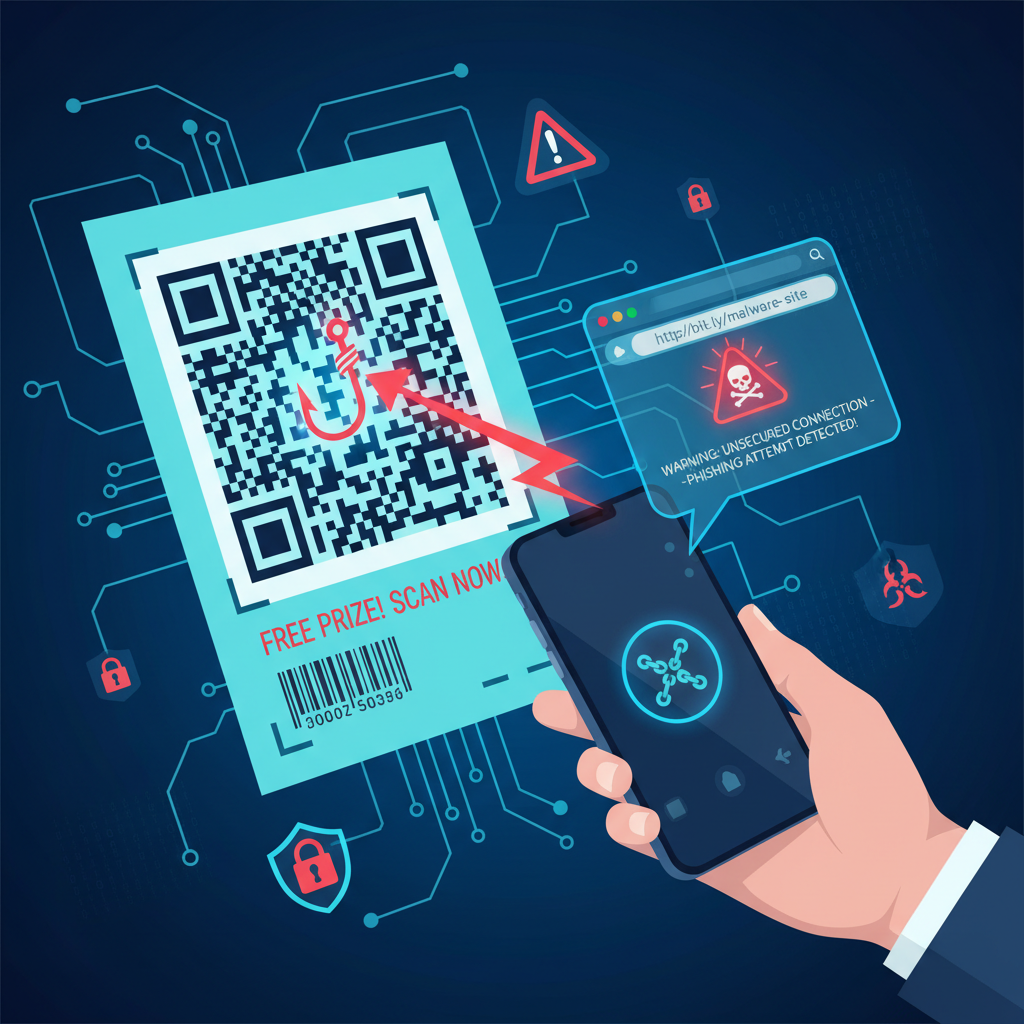
What Is Quishing and Why Are QR Code Phishing Attacks Increasing?
Quishing hides malicious destinations inside QR codes, bypassing traditional email security. As organisations use QR codes for legitimate purposes, attackers exploit employee trust to steal credentials and compromise accounts.
What Is Quishing?
Quishing is short for QR Code Phishing. The attack works by embedding a malicious website address within a QR code rather than displaying a clickable link.
When users scan the code with their mobile device, they are redirected to a malicious destination. Because the URL is hidden inside the QR code image, traditional email filtering may struggle to inspect it effectively.
Users are redirected to:
- Fake Microsoft 365 login pages
- Counterfeit banking portals
- Credential harvesting sites
- Malware download locations
- Fake supplier portals
Why Attackers Are Using QR Codes
QR codes have become common in business communications, invoices, event registrations and internal company systems. Employees have become comfortable scanning QR codes without questioning their legitimacy.
Attackers exploit this trust, resulting in a highly effective social engineering attack that bypasses many traditional security controls.
QR code phishing is no longer limited to email. Attackers increasingly place malicious QR codes in PDF documents, printed invoices, event registrations, business cards, posters, restaurant menus, collaboration platforms and physical mail, wherever users expect to scan them.
This creates challenges for:
- Email gateways
- URL reputation systems
- Traditional link analysis tools
- Mobile device management solutions
Quishing Requires a Unified Defence Strategy
QR code phishing attacks increasingly bypass traditional security controls because malicious destinations are hidden inside QR codes rather than visible links.
Modern organisations require more than email filtering and awareness programmes alone.
An effective defence strategy should combine:
- User Reporting
- Campaign Detection
- AI-Powered Analysis
- Human Validation
- Detection & Response
- Threat Remediation
- Human Risk Management
Together these capabilities help organisations identify, investigate and contain QR code phishing attacks before they result in compromise.
Why Mobile Devices Increase Quishing Risk
Many QR code phishing attacks move users away from managed corporate devices and onto personal smartphones.
This creates additional security challenges:
- Reduced Security Visibility
- Limited URL Inspection
- Weaker Monitoring
- Increased User Trust
- Mobile-First Attack Paths
- Faster Credential Theft
Because scanning often occurs outside traditional security controls, mobile phishing attacks can be harder to detect and investigate.
Mobile Security Considerations
- Personal Device Use
- Limited Visibility
- Weaker Controls
- Trust Exploitation
- Rapid Compromise
- Mobile-Only Paths
How AI Is Increasing Quishing Attacks
Artificial intelligence is making QR code phishing campaigns more convincing and easier to scale.
Microsoft reported QR code phishing campaigns growing at a rate of 270% per month during 2024, one of the fastest surges in phishing activity observed.
Attackers increasingly use AI to:
- Generate Personalised Lures
- Create Convincing Business Communications
- Mimic Legitimate Brands
- Improve Social Engineering
- Produce Contextually Relevant Messages
- Automate Campaign Creation
This combination of AI and QR code phishing creates a growing challenge for security teams.
AI-Enhanced Phishing Capabilities
- Personalised Lures
- Contextual Accuracy
- Brand Mimicry
- Scale and Speed
- Message Variation
- Campaign Automation
How A Quishing Attack Works
Quishing attacks follow a predictable pattern that exploits employee trust at each stage.
Step 1
Delivery
The victim receives an email containing a QR code, appearing to come from Microsoft, Royal Mail, DHL, internal IT teams or financial institutions.
Step 2
Scan
The user scans the QR code using their smartphone, believing the request is legitimate.
Step 3
Redirection
The QR code redirects the user to a malicious website: a fake Microsoft 365 login page, counterfeit banking portal or credential harvesting site.
Step 4
Credential Theft
The victim enters login credentials believing the page is legitimate.
Step 5
Account Compromise
Attackers gain access to corporate accounts and sensitive information.
Example Of A Quishing Email
From: security-noreply@microsofft-support.com
Subject: Microsoft Security Update Required
Your account requires verification.
Scan the QR code below using your mobile device to confirm your identity and avoid service interruption.
The QR code directs users to a fake Microsoft 365 login page. The page looks genuine. Credentials are stolen.
Nothing about the QR code itself appears suspicious. The risk only becomes visible after the destination is opened on a mobile device, making QR phishing particularly difficult for users to identify.
Campaign Intelligence Helps Identify Emerging Quishing Campaigns
QR code phishing campaigns evolve rapidly and often target multiple organisations simultaneously.
Phishing-specific campaign intelligence helps organisations:
- Identify Active QR Phishing Campaigns
- Detect Emerging Attack Techniques
- Monitor Credential Theft Activity
- Understand Attacker Behaviour
- Improve Investigation Context
- Accelerate Response Activities
Real-world phishing intelligence derived from millions of user-reported phishing emails provides early visibility into emerging QR code phishing campaigns before they spread across organisations.
Campaign Intelligence Benefits
- Campaign Identification
- Emerging Techniques
- Credential Monitoring
- Attacker Insight
- Investigation Context
- Response Acceleration
Common Warning Signs Of Quishing
Employees should remain alert for these indicators:
Unexpected QR Codes
Emails requesting urgent scanning activity from unfamiliar or unexpected senders.
Login Requests
QR codes directing users to authenticate accounts or verify credentials.
Urgent Language
Threats involving account suspension, security issues or service interruption.
Unfamiliar Senders
Messages originating from unexpected contacts or slightly misspelled domains.
Requests For Personal Information
Any QR code leading to credential or financial information requests.
Which Industries Are Being Targeted?
Quishing attacks affect organisations of all sizes. Attackers target both employees and customers.
The QR Phishing Defence Workflow
A connected pathway from suspicious QR code to organisation protected.
- Step 1
QR Code Received
- Step 2
Employee Reports Suspicious Email
- Step 3
AI Investigation
- Step 4
Campaign Detection
- Step 5
Threat Quarantine
- Step 6
Organisation Protected
How Cofense Delivers Unified Defence Against QR Code Phishing
User Reporting
Employees identify suspicious messages and provide valuable threat signals that feed into investigation and response workflows.
Campaign Intelligence
Real-world phishing intelligence provides context on active campaigns and emerging attacker techniques targeting your industry.
AI-Assisted Investigation
Automated analysis accelerates investigation and threat validation while humans provide contextual judgement and decision-making.
Campaign Detection
Threat clustering identifies broader QR phishing campaigns affecting multiple users and reveals attack infrastructure.
Threat Remediation
Malicious emails can be identified, contained and removed rapidly from inboxes before users scan QR codes.
Human Risk Reduction
Awareness programmes, simulations and behavioural analytics strengthen workforce resilience against sophisticated attacks.
Together these capabilities create a unified phishing defence strategy positioned as an integrated capability rather than individual products.
Detecting Quishing Is Only The First Step
Identifying a QR code phishing email does not eliminate risk.
Effective phishing defence should include:
- Threat Quarantine
- Automated Email Removal
- Campaign-Wide Remediation
- Threat Containment
- Incident Response
- Reduced Attacker Dwell Time
Modern organisations require the ability to remove threats as quickly as they can detect them.
Response Capabilities
- Threat Quarantine
- Email Removal
- Campaign Remediation
- Threat Containment
- Response Automation
- Reduce Dwell Time
Employee Reporting Creates Valuable Campaign Intelligence
Employees frequently identify suspicious QR code phishing emails before automated systems detect them.
User-reported messages provide:
- Campaign Intelligence
- Investigation Context
- Campaign Visibility
- Detection Opportunities
- Early Warning Signals
Reporting becomes significantly more valuable when integrated into investigation and response workflows.
Reporting Benefits
- Valuable Intelligence
- Investigation Context
- Campaign Visibility
- Detection Signals
- Early Warnings
- Response Capability
Combining AI and Human Expertise
Modern phishing defence increasingly combines automated analysis with human expertise.
AI helps security teams:
- Analyse Messages Faster
- Identify Threat Patterns
- Accelerate Investigations
Human analysts provide:
- Contextual Understanding
- Intent Validation
- Risk Assessment
- Decision-Making Expertise
AI + Human Advantages
The combination of AI and human validation helps organisations respond more effectively to sophisticated phishing attacks.
- Faster Analysis
- Pattern Recognition
- Contextual Judgement
- Risk Understanding
- Effective Response
- Better Decisions
How Organisations Can Improve QR Code Security and Prevent Quishing
The most effective defence combines employee awareness with strong reporting, campaign intelligence, detection and response capabilities.
Phishing Defence Training
Employees should understand how QR phishing works, what warning signs to look for and how to report suspicious emails.
Verify Before Scanning
Users should verify unexpected requests through trusted communication channels before scanning any QR code.
Multi-Factor Authentication
MFA reduces the impact of stolen credentials if a quishing attack succeeds.
Encourage User Reporting
Employees should be able to report suspicious emails quickly and easily using one-click reporting tools.
Campaign Intelligence
Access to phishing intelligence helps organisations identify active QR code campaigns targeting their industry.
Why Existing Security Controls Are Not Enough
Most organisations already deploy Microsoft Defender, secure email gateways, endpoint protection, identity security, multi-factor authentication, SOC services, SOAR and SIEM platforms, and DMARC with Zero Trust controls.
Despite these investments, quishing attacks continue to bypass preventative controls because users often scan QR codes using unmanaged mobile devices.
Successful QR phishing attacks frequently steal Microsoft 365 credentials, giving attackers access to Outlook, Exchange Online, Microsoft Teams, SharePoint, OneDrive and Microsoft Entra ID. From there, attackers can move laterally across cloud services, collaboration platforms and sensitive business information.
Cofense complements existing security investments through improved visibility, investigation, detection and remediation capabilities.
Understanding Human Risk and QR Code Phishing
As QR code phishing attacks become increasingly sophisticated, organisations require greater visibility into human cyber risk.
Human Risk Management helps organisations understand:
- Reporting Behaviour
- Phishing Susceptibility
- High-Risk Users
- Department Risk Trends
- Behavioural Improvement
- Security Culture Maturity
Human Risk Management enables organisations to reduce risk proactively rather than reactively.
Key Risk Metrics
- Reporting Behaviour
- Phishing Click Rates
- High-Risk Users
- Department Trends
- Culture Maturity
- Risk Improvement
The Future of QR Code Phishing
QR code phishing attacks are expected to become increasingly sophisticated.
Future quishing campaigns may incorporate:
- AI-Generated Content
- Personalised QR Campaigns
- Dynamic QR Destinations
- Mobile-First Attack Paths
- Automated Social Engineering
- Multi-Channel Phishing
Organisations will increasingly require:
Campaign intelligence, rapid detection and coordinated response capabilities to defend against evolving QR code phishing attacks.
- Campaign Intelligence
- Rapid Detection
- Campaign Visibility
- Fast Response
- Human Risk Management
- Continuous Improvement
Building a Unified Defence Against QR Code Phishing
QR code phishing attacks increasingly bypass traditional security controls and exploit employee trust.
Effective protection requires more than awareness programmes alone.
Modern phishing defence combines:
Business Outcomes
- Faster phishing investigations
- Reduced attacker dwell time
- Stronger threat visibility
- Improved workforce resilience
- Lower employee cyber risk
- Faster response and remediation
- Improved operational maturity
These outcomes help organisations respond more effectively to QR code phishing attacks.
Quishing FAQs
UK Cofense Authorised Distributor
Authorised Cofense distribution for UK organisations.
QR Phishing Specialists
Dedicated expertise in QR code phishing defence.
Microsoft 365 Experts
Deep Microsoft 365 phishing protection experience.
Human Risk Specialists
Behavioural analytics and human risk management.
Enterprise Deployment Experience
Large-scale Cofense rollout and support.
UK & European Support
Local support across the UK and Europe.