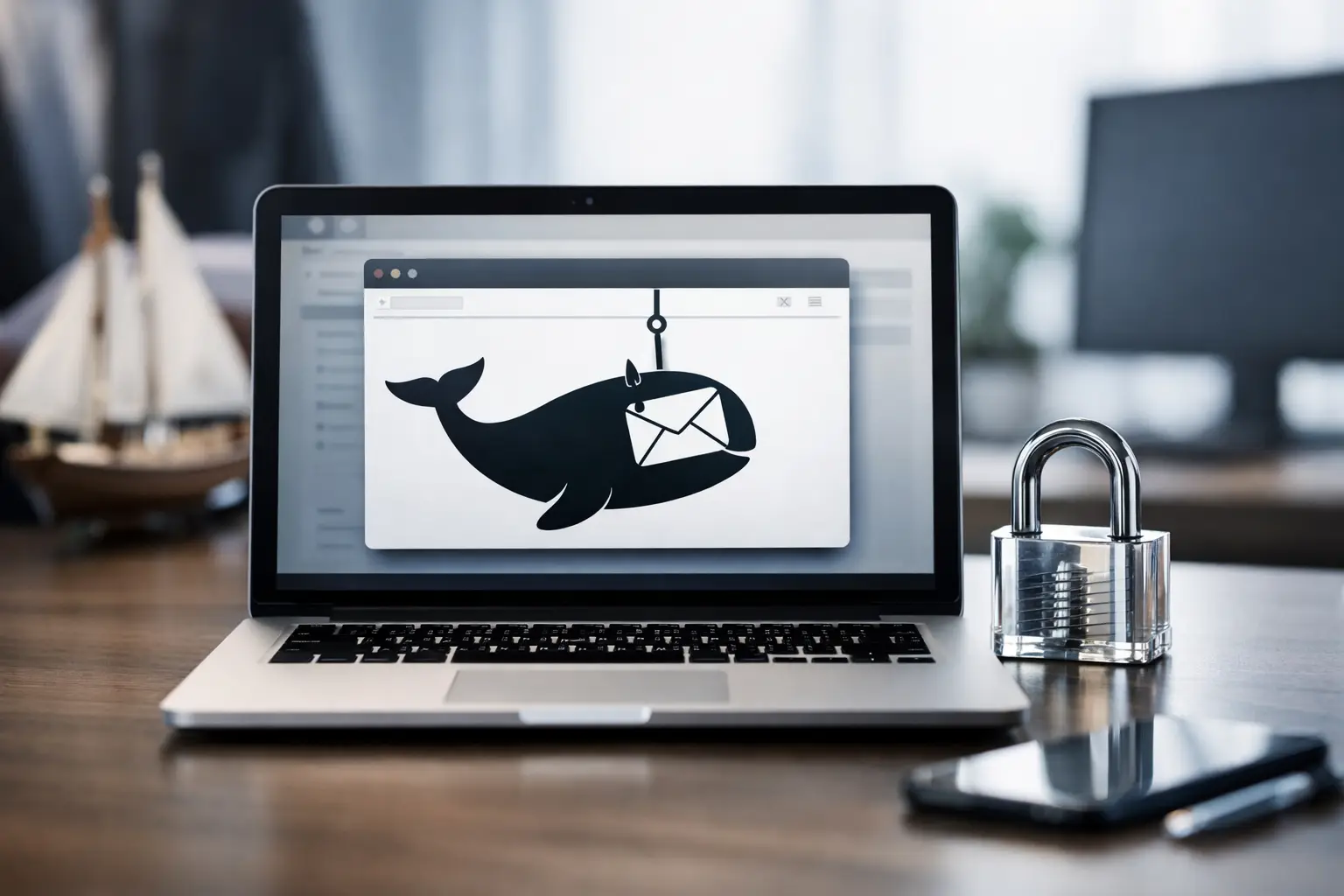
A finance director receives an email that appears to come from the chief executive. It refers to a confidential acquisition, uses the right tone, and asks for an urgent payment before the market opens. There is no obvious malware, no poorly written copy, and no generic greeting. This is precisely why whaling attack prevention for businesses cannot rely on conventional spam filtering or annual awareness training alone.
Whaling is a targeted form of business email compromise that focuses on senior executives, finance teams, payroll staff, legal departments and others with authority over money, sensitive data or strategic decisions. Attackers research the organisation, impersonate trusted people or suppliers, and create pressure that bypasses normal judgement. The eventual loss may be an unauthorised payment, diverted salary details, disclosure of legal documents, or compromised Microsoft 365 credentials that enable further fraud.
Why whaling attacks bypass ordinary email controls
Most whaling campaigns are designed to look like legitimate business correspondence. The attacker may register a lookalike domain, compromise a genuine supplier mailbox, or use a personal email account while impersonating a senior colleague. They may also take over an executive's account and use authentic email threads, signatures and contact history to make a request appear credible.
This means technical controls remain necessary but are not sufficient in isolation. Secure email gateways and Microsoft 365 protection can block known malicious links, attachments and sending infrastructure. Yet a payment-diversion request may contain no malicious payload at all. Its effectiveness rests on social engineering, context and urgency.
Generative AI has increased the quality and scale of this deception. Poor grammar is no longer a dependable warning sign, while public information from company websites, regulatory announcements and social platforms can provide attackers with convincing detail. Organisations need controls that assume some suspicious messages will reach inboxes and that staff will need an effective way to challenge them.
Whaling attack prevention for businesses starts with process
The strongest defence combines email security with financial and operational verification. A message requesting a high-value payment, a change to bank details or sensitive information should never be treated as authoritative purely because it appears to come from a senior person.
Verification should take place through a known, independent channel. That might mean calling a verified telephone number, consulting an approved contact record, or confirming the request in a pre-existing collaboration channel. Replying to the suspicious email, using the number in its signature, or accepting a last-minute exception does not provide independent assurance.
For finance and procurement functions, payment controls need to reflect the threat. Dual approval, documented call-backs for changed supplier details, payment holds for new beneficiaries and segregation of duties create useful friction. The trade-off is speed. In time-critical operations, teams may feel pressure to bypass a check that appears administrative. The answer is not to remove the control, but to define clear escalation routes and make the verification process fast enough to be used under pressure.
Executive teams also need to model the behaviour expected of others. If leaders routinely send urgent requests from personal accounts, ask staff to avoid normal approvals, or communicate instructions through informal channels, they create conditions that attackers can exploit. Clear executive communication practices are a security control.
Configure Microsoft 365 to reduce impersonation risk
Microsoft 365 is a central communication platform for many UK organisations and should be configured as part of a layered anti-whaling strategy. Domain authentication controls, including SPF, DKIM and DMARC, help receiving systems assess whether a sender is authorised to use a domain. DMARC enforcement is particularly valuable for reducing direct spoofing of an organisation's own domain, although it will not stop lookalike domains or compromised third-party accounts.
Mailbox protection should identify display-name impersonation, unusual sender domains, external email indicators and risky forwarding behaviour. Policies should also address legacy authentication, multi-factor authentication coverage, privileged account protection and suspicious inbox rules. Attackers who gain access to a mailbox often create forwarding rules or hide replies to sustain an impersonation campaign.
Configuration requires care. Aggressive blocking can interrupt legitimate supplier communication, particularly where organisations use multiple sending services or complex subsidiary domains. Establish a baseline, monitor false positives and ensure that exceptions have named owners and review dates. A control that is switched off after operational complaints delivers little assurance.
Make reporting easy enough to use
Employees are often the first people to notice that a message feels wrong. They may recognise an unfamiliar payment pattern, an unexpected request from a director, or a supplier whose writing style has changed. That insight is valuable only if it reaches the security team quickly and with the evidence needed for investigation.
A reporting button integrated into Outlook gives users a simple route to submit a suspicious message without forwarding it incorrectly or raising an incomplete help desk ticket. It also makes reporting a normal part of work, rather than an admission that someone nearly made a mistake. The desired behaviour is early reporting, including when the user is uncertain.
Training should prepare roles for the attacks they are likely to receive. Finance teams need realistic payment-diversion scenarios. Executive assistants may need to validate urgent diary, travel or document requests. HR and payroll teams should practise identifying requests to alter bank details or release employee information. Generic phishing training has a role, but role-based simulations and short reinforcement campaigns better reflect the decisions that create material business risk.
Avoid measuring success solely by simulated phishing failure rates. Report volumes, time to triage, repeat reporting behaviour, high-risk departments and the proportion of confirmed threats removed from mailboxes reveal more about whether the organisation is improving its human risk management.
Treat every report as intelligence, not just a ticket
A reported whaling email may be the first visible sign of a wider campaign. Security teams need a defined phishing triage process that establishes who sent the message, whether it was delivered elsewhere, whether users interacted with it, and what immediate action is required.
The investigation should consider sender authentication results, message headers, URLs, attachments, impersonated identities, related domains and any connected mailbox activity. If a supplier account appears compromised, the team may need to notify the supplier through an independently verified route while protecting evidence for incident response.
Speed matters because the same campaign may reach dozens or thousands of recipients. Once an email is confirmed as malicious, remediation should locate and remove matching messages from affected Microsoft 365 mailboxes, including copies that were forwarded or delivered to shared accounts where possible. Users who clicked, replied or disclosed information need proportionate follow-up, which may include credential resets, endpoint review, payment recall procedures or legal and compliance escalation.
This workflow benefits from specialist capability. Wise Fish, as a Cofense Authorised Distributor, supports organisations in connecting employee reporting, phishing triage, threat intelligence and remediation into an operational phishing defence programme. The objective is not simply to process more reports, but to turn them into faster containment and stronger preventative controls.
Test the response before a real payment request arrives
A tabletop exercise is an effective way to expose weaknesses that policy documents miss. Use a scenario involving a convincing executive request, a supplier bank-detail change or a compromised mailbox. Include finance, IT, security operations, legal, communications and the relevant business owner. Then test who verifies the request, who can halt a payment, who investigates the email, and who decides whether other mailboxes require remediation.
The useful outcome is a set of operational decisions: named escalation contacts, verification standards, reporting routes, authority to quarantine or remove messages, and communication templates. Rehearsal also helps teams distinguish a suspected whaling attempt from a confirmed fraud incident, where banking, regulatory and contractual obligations may apply.
Whaling prevention is most effective when staff are supported to pause, report and verify without being criticised for delaying an urgent-looking request. Give them a clear process, make the security team responsive, and use each reported message to improve the next layer of defence.